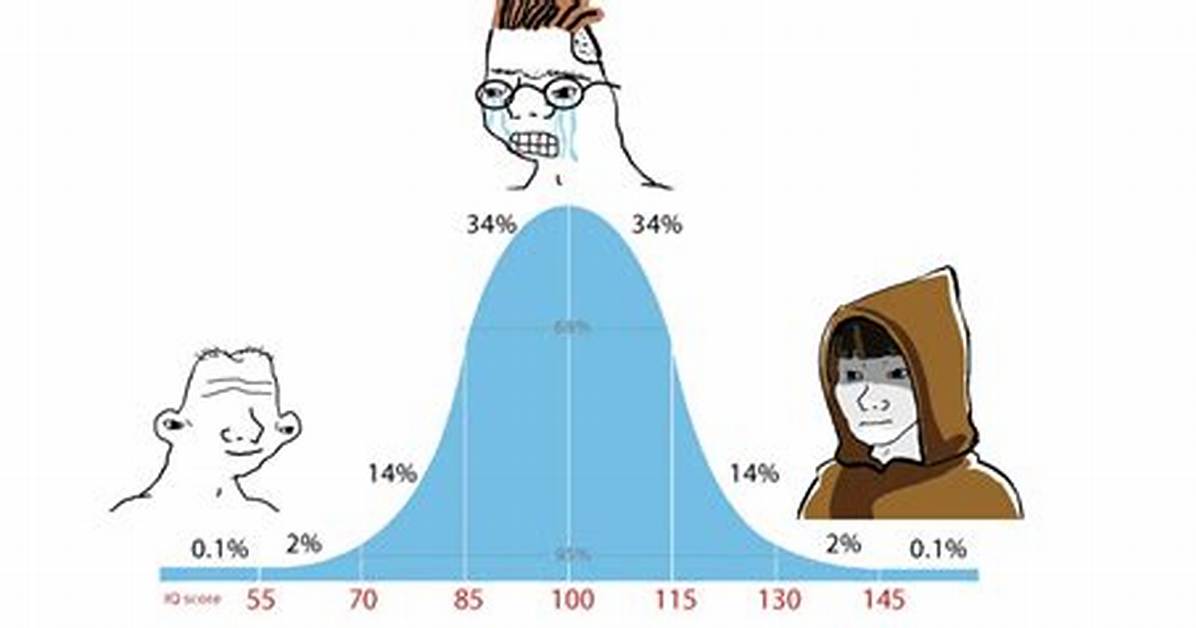
The Bell Curve meme has become a staple in the realm of internet culture, often used to represent various social and psychological concepts. This meme, which visualizes the distribution of traits, intelligence, or behaviors, has captured the imagination of many and sparked discussions about its implications. In this article, we delve deep into the origins, variations, and significance of the Bell Curve meme, exploring how it has evolved and influenced online interactions.
The Bell Curve meme is rooted in statistical theory, specifically the normal distribution, which is often depicted as a bell-shaped curve. This meme has been adapted and transformed into various formats, making it a versatile tool for humor, satire, and commentary. By examining its different iterations, we can better understand its role in shaping conversations around intelligence, social status, and cultural commentary.
As we navigate through this article, we will provide insights into the Bell Curve meme's history, its various applications, and its reception among different audiences. Additionally, we will explore its relevance in contemporary discussions about education, intelligence, and societal norms, ultimately illustrating why this meme has resonated with so many people online.
The History of the Bell Curve Meme
The Bell Curve meme originated from the statistical concept known as the normal distribution, which describes how traits or behaviors are distributed within a population. This concept was popularized in the 1994 book "The Bell Curve" by Richard Herrnstein and Charles Murray, which controversially linked intelligence to socio-economic status and race. The book ignited significant debate, making the bell curve a symbol of contentious discussions around intelligence and meritocracy.
As the meme began to circulate on platforms like Reddit and Twitter, it evolved into a visual representation that could be applied to various contexts. The simplification of a complex statistical concept into a meme format allowed for easier engagement and sharing among users, contributing to its widespread appeal.
Key Milestones in the Evolution of the Meme
- 1994: Publication of "The Bell Curve"
- Early 2000s: Emergence of the meme in online forums
- 2010s: Widespread use on social media platforms
Variations of the Bell Curve Meme
Over the years, the Bell Curve meme has taken on numerous forms, allowing it to be adapted for various topics. Some common variations include:
- Intelligence Levels: Depicting the distribution of intelligence levels among different groups.
- Social Status: Illustrating how social behaviors are perceived across different societal strata.
- Humor and Satire: Using the curve to poke fun at societal norms, expectations, and stereotypes.
Each variation serves a unique purpose, whether it’s to critique societal standards or to humorously reflect on the absurdities of life. The adaptability of the Bell Curve meme is part of what has made it so enduring and relevant in online discussions.

